

When you first introduce a dog training platform into your routine, it’s natural to look at that 60cm x 40cm surface and wonder: “Is my dog actually going to fit on there?”
If you have a large breed, you might worry that the place board is too small. On the other hand, if you have a tiny Terrier, you might wonder if a standard dog place board is too big to be effective.

At Anglian Dog Works, we get asked this question a lot. The short answer? Your place board is likely the perfect size. In place board dog training, the goal isn’t to give your dog a "lounge" area; it’s to create a precise mental and physical boundary.
The Industry Standard: Why 60cm x 40cm Works
The 60 cm x 40 cm place board is the industry standard for a reason. Originating in the gundog training place board world for Spaniels and Retrievers, this size was designed to accommodate the "sit" position perfectly.
Because gundog training—and most precision obedience—is based around the sit, we aren't concerned with the dog’s full length from nose to tail. We are only concerned with the "footprint" of their sit on the place board.
Why a Smaller Place Board is Often Better
It might feel counterintuitive, but a place board that is 'just big enough' for your dog is actually a better teacher.
- For Large Breeds: A "tight fit" on the dog training platform provides immediate biofeedback. If a Doberman or a GWP has to be careful with their paw placement to keep all four feet on the place board, they become more aware of their body.
- A straight sit often aids training goals, for example, correct alignment next to a handler for a straight sendaway on a retrieve.
- For Small Breeds: While a Cocker Spaniel puppy could technically fit on a smaller surface, the standard place board size still provides a distinct "target".

If a place board is too large—say, two meters square—the "criteria" becomes blurry. The dog can be anywhere in that square, which fails to create the precise delivery to hand or the sharp recall finish we are looking for with place board dog training.
Height, Grip, and the "Slippery Step" Danger
When choosing a dog training platform, the surface area is only half the battle. The texture and safety of the place board are another important consideration.
The Problem with Repurposed Steps
Some boards on the market are actually repurposed household steps marketed by big corporations as place boards in order to turn a quick buck (we have seen them available marketed for humans at £14 and remarketed for dogs at £40+). While they might look like they have a rubber grip, that surface is often designed for human shoes, not canine paws. For a dog, these make for a very poor place board. If a dog slips or has an accident on a slippery place board, it can shatter their confidence and stall your training journey for months. As a trainer, i want a dog running back on a retrieve or recall confident at full speed, not hesitant and worried about a slip.
If purchasing a rubber-topped board, you want to choose one with a textured rubber finish, like on our pivot boxes and position boxes, not smooth.

The Artificial Grass Advantage
At Anglian Dog Works, our place boards use high-quality artificial grass. This provides:
- Superior Grip: Even when wet or muddy, the dog can "dig in" and feel secure on the place board.
- Visual Contrast: The place board stands out clearly against natural grass or patio stones, making the "target" obvious to the dog.
- Durability: Our place boards are built with treated timber to withstand the British weather—we have place boards still in use after six years of being outside!
How the Place Board Corrects "Sloppy" Finishes
The physical edge of the place board acts as a "braking system." If your dog has a habit of overshooting you during a recall or "dancing" just out of reach during a delivery, the place board fixes this.
By rewarding the dog only when all four paws are on the place board, you create a mental target. The dog learns that the reward doesn't happen "near" the owner; it happens on the place board. This eliminates the momentum that causes dogs to overshoot and replaces it with a clean, controlled finish.
Pro-Tip: "Deactivating" the Place Board
One of the biggest mistakes owners make is letting the dog lounge on the place board while they are chatting or taking a break. If the dog lies down on the place board because they are bored, the "precision" of the sit-stay starts to fade.
The Anglian Dog Works Method: When you aren't actively training, flip the place board over. By turning the place board grass-side down, you "deactivate" the tool. This prevents the dog from offering unrewarded behaviours and keeps the association with the place board strictly focused on "work mode" and high-value rewards.
How to Get Your Dog Started
If your dog is tentative about stepping onto the place board, don't force them.
- Lure: Use a high-value treat as a "magnet" at their nose.
- Guide: Slowly lead them onto the place board.
- Reward: The moment all four paws touch the place board grass, reward heavily.
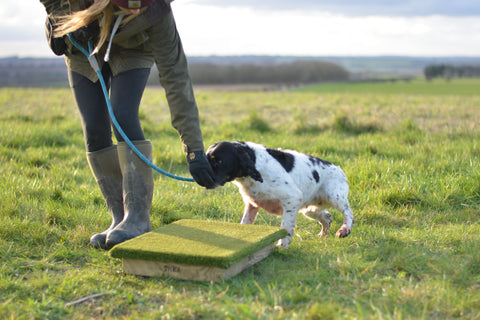
For a step-by-step deep dive into these techniques, check out our Place Board eBook or join our Online Place Board Course.
Summary: Size vs. Purpose
Is your dog's place board too small? If they can sit on it with all four paws, the answer is no. A place board is a precision tool, not a bed. Embrace the tight fit, focus on the grip, and watch how a clear physical boundary leads to a more focused, obedient dog.
Tags:
Related articles
-
Jan 01 2025
Creative Uses for Place Boards in Dog Training
-
Nov 21 2024
Can a Dog Be Trained in Just 2 Weeks? Yes, Here’s How!
-
Nov 21 2024