
Teaching a Straight Sit Using a Place Board
Teaching a Straight Sit Using a Place Board
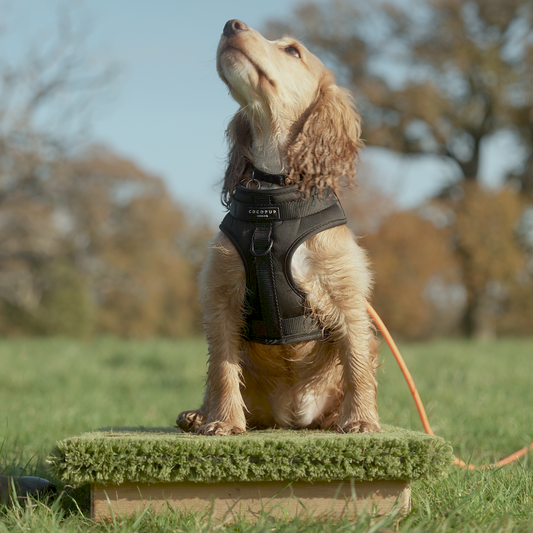
This work was inspired by a recent gundog lesson with Lucy at Canine In-Tuition, with my Cocker Spaniel Thea.
This blog explains why straight sits matter, what causes crooked sits, and how I’m using a Place Board to retrain alignment.
Why a Straight Sit Matters in Gundog Training
When I line my dog onto a memory or blind retrieve, I want her already facing the same direction as me. If her body is aligned with my heel, her initial trajectory is far more likely to be correct.
What I was seeing instead was this:
-
She would sit at roughly a 45-degree angle
-
Her body oriented towards me, not forwards
-
She was facing where she expected the reward to come from, not where I wanted her to run
Up close, that angle looks insignificant. But in gundog training, small errors multiply over distance.
Alignment and Distance
In Gundog Club Grade 2 for a Hunter Retriever (Spaniel), marked retrieves can be out to approximately 40 metres. A few degrees out at heel may not look like much, but over that distance it can mean the difference between a confident, straight retrieve and a dog that drifts, hunts early, or needs unnecessary handling.
As retrieves get longer and more technical, initial alignment becomes even more important.
The Wonky Sit Isn’t Stubbornness
This is a really important point.
The dog isn’t being awkward or lazy — she’s responding to what has previously paid off.
Anatomically, my dog is equally strong on both sides. I walk her on both my left and right. She is perfectly capable of a straight sit and often offers one at home without any equipment.
So the crooked sit isn’t a physical limitation.
It’s a learnt behaviour.
Dogs Repeat What Works
If a sit has become crooked, it’s usually because that position has been reinforced — often unintentionally. Facing the handler tends to predict reward delivery, feedback, or interaction, so the dog starts to orient that way.
Dogs repeat what works.
The solution isn’t physical correction. It’s removing reinforcement for the wrong picture and making the right picture very clear.
Why I’m Using a Place Board
Letting the Setup Do the Work
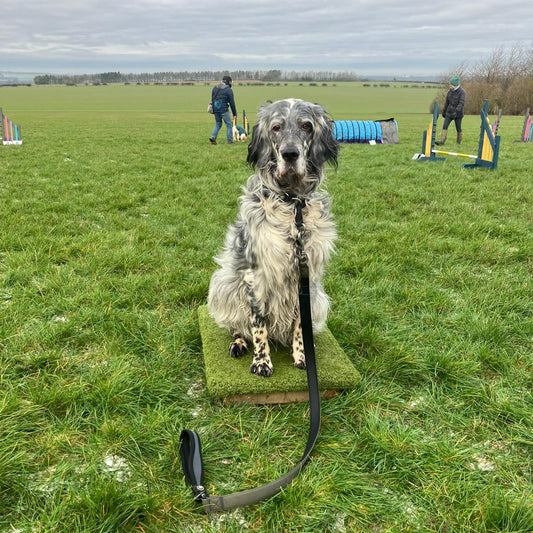
Place boards are a classic example of letting the environment teach the behaviour, rather than relying on constant handling from the trainer.
A Place Board removes ambiguity. It gives the dog a clear physical reference point for where their body should be, without pressure, repetition, or verbal micromanagement.
This is exactly why I use the
👉 Anglian Dog Works Place Board – Dog Training Platform
How the Place Board Aids Dog–Handler Communication
The Place Board I use has a rectangular design measuring 60cm x 40cm. That shape matters.
-
The long edge encourages forward alignment
-
The short edge discourages angled sits
-
Its “butt-sized” dimensions naturally guide position
Because it’s fixed and clearly defined, it gives the dog immediate feedback about what straight feels like — without verbal or physical pressure.
That clarity improves dog–handler communication and speeds up learning.
My Goal With This Training
The end goal isn’t a perfect sit on a board.
It’s this:
-
When walking at my side
-
On hearing the cue sit
-
My dog sits immediately, straight, and in line with my heel
Not:
hear sit → shuffle into preferred wonky position → then sit
Nor:
following food lure instead of actually understanding
Limiting the Lure From the Start
I am very deliberate about how much I lure.
Why I Limit It
I only lure the first couple of repetitions. I don’t want the behaviour to become dependent on my hand.
The goal is understanding, not food following.
Food is used to:
-
Clarify the position
-
Reinforce the correct picture
-
Then fade quickly
Step-by-Step: Teaching the Straight Sit
Phase 1: Introducing the Concept at Home
This is done in a low-distraction environment first.
Setup
-
Place board positioned with the short edge facing the dog
-
I walk alongside the long edge
-
Food is held directly in front of the dog’s nose
-
I draw the food upwards in line with my trouser seam
-
Guide into a sit
-
Reward in position
I only lure the first two repetitions like this.
Phase 2: Same Setup, Reduced Help
-
No lure onto the board
-
Food only produced in line with my trouser seam
-
Cue sit
-
Reward in position
TIP: Using a Physical Barrier
Put the board against a wall.
This:
-
Prevents swinging out
-
Helps reinforce the straight picture
-
Makes success easier for the dog
The sequence:
-
Onto the board
-
Sit
-
Reward
-
Release
-
Turn
-
As she returns, cue sit
-
Reward
Repeat calmly and consistently.
Phase 3: Removing the Wall
Once the picture is clear:
-
Board away from the wall
-
Same criteria
Phase 4: Taking It Into the Field
Only once the concept is solid do I:
-
Move into new locations
-
Begin using it within dummy drills
This is a three-week goal for me.
Behaviours need to be:
-
Taught
-
Proofed
-
Generalised
A straight sit at home doesn’t automatically transfer to the field — it has to be trained.
What I Do If She Gets It Wrong
If I cue sit and she moves into a wonky one:
-
I don’t repeat the cue
-
I don’t release
-
I don’t physically push her
Instead:
-
I calmly reposition
-
Use a brief lure if needed
-
Reward the correct position
Why This Matters for Tests and Beyond
In graded gundog work, marks are often lost not on the retrieve itself, but on the moments either side of it:
-
The sit
-
The alignment
-
The response to the stop whistle
If a dog hears the pip beside me and moves into a preferred angled position before sitting, those small movements can cost marks — and clarity.
Final Thoughts
This kind of work is easy to overlook, but it pays dividends later.
Place boards make the learning picture clearer, reduce the need for correction, and help dogs truly understand what we’re asking — not just guess where the reward might come from.
If you’d like to try this yourself, you can find the
👉 Anglian Dog Works Place Board – Dog Training Platform
on my website.
If you give it a go, I’d love to hear how you get on.
Leave a comment, or tag me @angliandogworks on social media — and let me know in the comments if you’d like an update on how this progresses over the next few weeks.
Tags:
Previous
Creative Uses for Place Boards in Dog Training
Next
Is My Dog’s Place Board Too Small? A Trainer's Guide
Related articles
-
May 25 2026
Is My Dog’s Place Board Too Small? A Trainer's Guide
-
Jan 01 2025
Creative Uses for Place Boards in Dog Training
-
Nov 21 2024
Can a Dog Be Trained in Just 2 Weeks? Yes, Here’s How!
-
Nov 21 2024